
As all Christians learn growing up, God punishes us because he loves us. He sends us problems to sand down our sinfulness like sandpaper because he cares. However, there were some major prayers that I prayed as a youth that were never answered, and initially I settled for the answer that God was testing me with his silence, but eventually after a few decades of unanswered prayers, as an adult, I came to the conclusion that there was no god. I eventually moved to astrology, where my first stop was Vedic astrology from India. To my great relief, I didn’t have to beg, prostrate myself or self-flagellate before my [imagined] glare of a dissatisfied deity anymore. I could rest in the knowledge that Saturn was responsible for my unanswered prayers– he is after all a slow-moving planet and needs his time– and once I had burned off my bad karma from a previous life, he would give me what I was wanting so badly. However, a couple years with the vedic understanding of Saturn was enough for me to recognize that I was still self-flagellating, but in a different way. It seemed hard to conceive what kind of bad person I was in a previous life that 40 years of trying to appease the wrath of a deity wasn’t enough.
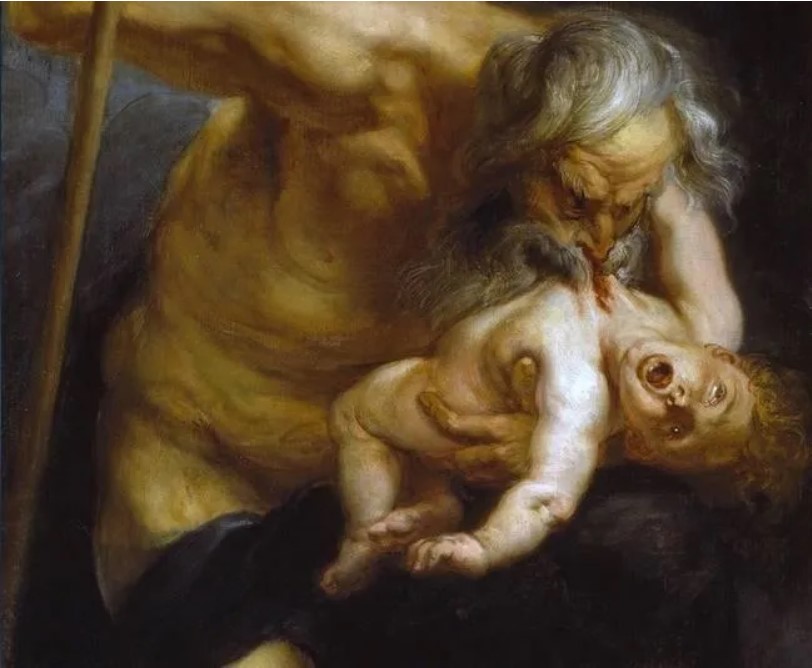
After Vedic astrology, I turned more fully to the western understanding of Saturn as the archetype of discipline and contraction, and investigated the idea of integrating Saturn’s qualities, which I am still working with; however, there is a way in which I am not comfortable with the western version of Saturn either- that he is a loving fatherly figure who sends difficulties our way to make sure our lives are built on a solid foundation. I am grateful for certain problems in my life and I’ve become a better person because of them. However, Saturn’s negligence of my long-held requests, as well as his predictable obstacles that appear like clockwork during a task related to the house he rules in my chart, would seem almost ridiculous if we’re going for the metaphor of a loving parent trying to teach us a lesson. Rather, he seems almost dumb in the sense of not being able to hear, or animal-like, like an energy without intelligence behind it. On a larger scale, it’s politically and economically naive to call Saturn loving. It comes from a place of privilege to suggest that Saturn crushes and humiliates us, and kills our loved ones for our own good. Any astrologer who is a student of history, politics or economics can see how racism, financial inequality, political oppression, and genocide all arise to some degree from Saturn’s tense aspects.
I am wrestling with Carl Jung’s idea of God as a dumb force that acts out a particular archetype, like an animal with limited or no intelligence behind it. In his Answer to Job, Jung is extrapolating from Job’s complaint about God’s silence here, cheering on his line of reasoning:
“Unconsciousness has an animal nature. Like all old gods, Yahweh has his animal symbolism with its unmistakable borrowings from the much older theriomorphic gods of Egypt, especially Horus and his four sons. Of the four animals of Yahweh, only one has a human face…. Ezekiel’s vision attributes three-fourths animal nature and only one-fourth human nature to the animal deity, while the upper deity, the one above the “sapphire throne,” merely had the “likeness” of a man. This symbolism explains Yahweh’s behavior, which, from the human point of view, is so intolerable: it is the behavior of an unconscious being who cannot be judged morally. Yahweh is a phenomenon and, as Job says, “not a man”. 1
I’m still trying to figure out what I think about Saturn, the planet who gives form to things, but I don’t think much would be lost if we removed the anthropomorphism from Saturn and just allowed him to be sandpaper that is capable of sanding as well as killing. As a footnote to the above quote, Jung adds,
“The naive assumption that the creator of the world is a conscious being must be regarded as a disastrous prejudice, which later gave rise to the most incredible dislocation of logic.”
He goes on to point out the disconnect between God and the the evil he created, but I want to change his last word “logic” to “consciousness” because I want to take this idea in a different direction. My next sentence would be, “Had the early Christians held onto the Egyptian concept of Satan (Set) that they initially inherited as a shadow to integrate, or at least a weight to lift to grow moral muscle mass, they may have recognized their own faces in their psychological-projection-god.” I don’t think we do suffering any favors when we put an anthropormized face with intelligence behind it. Saturn is, after all, just a planet, and we understand astrology to apply its forces on our lives through gravity. “He” is the bearer of an archetype, yes, but I think it’s confusing to the sufferer to say that he cares.
- Jung, Carl, Psychology and Religion: West and East, 2nd Ed. Bollingen Series, Princeton, 1969. Pg. 383. ↩︎