Shortly after ICE agent Jonathan Ross killed Renee Nicole Good, the Trump administration excused it by saying Ross was a victim of PTSD, from having been dragged by a car while in combat. In this blog post, I’ll explain how the Trump administration is co-opting the religious function of the mind to create an elaborate victimhood out of fascism, an inside-out world that celebrates the ego over our divine nature.
The Republican-Democratic fight we’re in today is a fight for democracy, which is inherently a fight for secular individualism.
On the surface, Carl Jung seemed pro-religious, but he was more a Gnostic believer than a Catholic one. He believed that God only existed in the psyche of men and women, and yet he believed that the religious function of the psyche was important. Our religious function is the instinctual part of us that strives toward the Transcendant.
His definition of religion was “‘the sense of conscientious regard for the irrational factors of the psyche and individual fate’, or ‘… the careful observation and taking account of certain invisible and uncontrollable factors,… an instinctive attitude peculiar to man.'” (Odajnik, 2007, pg. 54)
So the part of us that finds meaning for those magical moments of coincidences and synchronicities. And yet he believed projction onto the church and God was an appropriate and harmless way to service the religious function of humankind.
Jung believed that the religious function could be abused and appropriated if people didn’t have an appropriate container for their shadows and projections. In his book on Jung and Politics, Volodymyr Walter Odajnyk says that “Jung maintains that the communist or fascist state’s absorption of man’s religious feelings is one of the advantages that such a state possesses over the secular democratic one.”
Being deprived of one set of gods, mankind will only create others. Therefore, given the modern antireligious bias together with the elevation of the state to the supreme principle, the religious function often reappears in the deification of the state. The state simply takes the place of God; “the at is why, seen from this angle, the social [or fascist] dictatorships are religious and State slavery is a form of worship.” Without too great an effort, the state obstains the same uncritical enthusiasm, self-sacrifice, and love that were formerly bestowed upon the Church. (Odajnyk, pg. 54)
So what happens when the state is working together with the church to co-opt peoples’ religious function? A diligent person needs other places to project onto! As someone who used her religious function to embark on the self-observation path, I cannot derive any other conclusion reading Jung that the individuation process is a process of reclaiming one’s projections off of the church and God, taking responsibility for them, and integrating them into the self, thus becoming a psychological adult (although, there is so much work to do- do we ever reach adulthood?). Reclaiming one’s projections makes a person more whole, which also happens to be the goal of Enneagram work (or we could simply call this mindfulness or Buddhist work). Self-observation work attracts people who want to claim back the un-owned parts of themselves that they’ve projected onto various institutions, leaders, pets, children, lovers, family members, bosses, whoever; and incorporate their shadow qualities that were too difficult to carry in their younger years. Projecting onto the church is passing the buck of responsibility to the church, which inherently (when mixed with politics as the evangelical church has been for decades) wants us to remain psychological children. The Evangelical church in the US is leveraging that religious function in humans today to draw adherents away from themselves toward theocracy, the very thing my ancestors fought against.
While today’s American extremists are the ones who are fighting for state-sponsored religion, the Reformation, armed with the newly-invented printing press, was a fight with the Catholic state for secular individualism. The Reformation wasn’t completely secular, but it acknowledged the divine spark in each of us, which meant that papal mediation between individuals and God was no longer necessary. Martin Luther believed that people should be allowed to read the Bible and interpret it for themselves. But while Luther still upheld the legitimacy of magistrates to lead churches, the Anabaptist movement that split off from Luther drew an ever harder line between separation of church and state: their desire for adult baptism was a way of saying, “we will decide if and when we decide to join the church [by baptism], which doesn’t preclude us from being citizens.” In his book on Mennonites’ involvement in politics from 1525 to 1980, James Urry writes,
“Their insistence on adult baptism questioned how subjects were incorporated into social-political communities and how their allegiance to secular and sacred authorities was secured. Their refusal to swear an oath was viewed as seditious, a threat to the legitimacy of rulers and the loyalty of their subjects, by a people who, in matters of conscience, would accept only the final authority of the Word of God as revealed in the Bible.” (Urry, 2006, pg. 18)
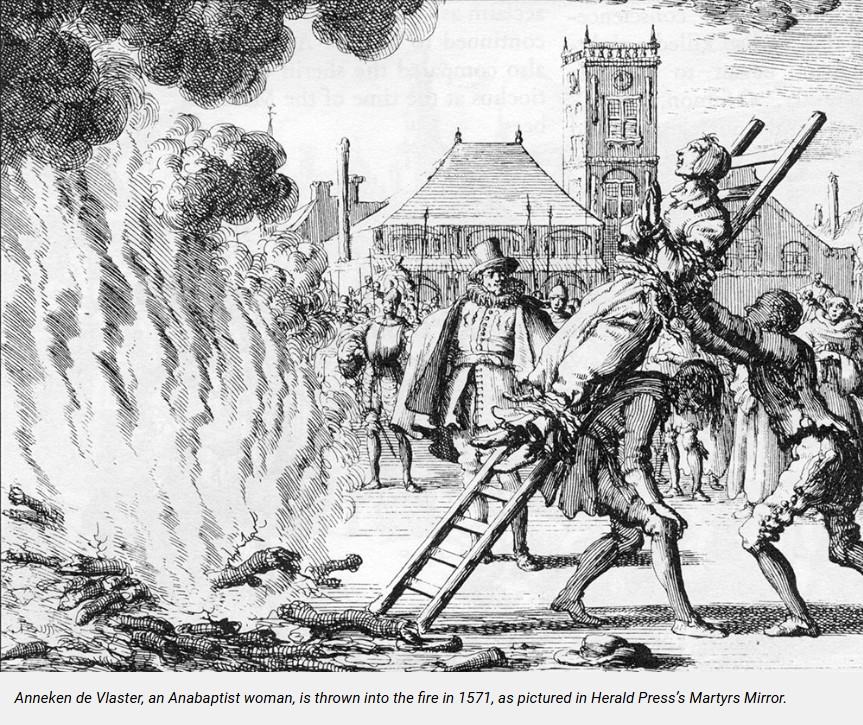
Anabaptists’ rebellion against the Pope led to brutal state-sponsored killings. They were burned at the stake and drowned, which led thousands of Anabaptists to flee to Prussia. I’m reflecting on this because this is my lineage- our Mennonite ancestors fled persecution from the Dutch government in the 16th century- our crime was refusing forced church adherence. And yet, today, second- and third-generation Canadian and American Mennonites are witnessing with horror, our own friends and family using what our ancestors fought for- freedom from the church- to fight for “freedom” from secular government to go back to an oppressive state-sponsored church again. It’s a mind-blowing, agonizing irony. Trump and the American evangelical church have co-opted the religious feeling of its adherents to create a fake victimhood, a false egoic emergency to unleash violence on its citizens. They have co-opted the reglious function of its adherents by immitating the divine spark that Lutherans recognized at the Revolution. It functions by attuning its ear to cries of actual victims of oppression and imitating them so that people are confused what actual oppression looks like.
In the Enneagram tradition, we have built on the worlds of Jung and Freud, particularly around the idea of personality types, as that is that basis for our holy and dynamic diagram. Our understanding of the personality is that it is a powerful, deceptive force, unique to our type, that immitates one of nine divine qualities of Essence. One could think of Essence as a river flowing deep below the hardened crust of our personality.
“Our souls are malleable, impressed and shaped by what we encounter in life, and this is particularly the case during our formative years before our defensive structures solidify. During this time, we develop a personality, a structured or fixed sense of ourselves and of reality, which forms the outer layer of our soul and which in time separates us from the Divine within as we progressively become identified with it. … The work of spiritual development,.. is to reconnect with the spiritual depths of our soul- our essential nature.” – Sandra Maitri, The Spiritual Dimension of the Enneagram, pg. 8.
If our personality is made up of three components- the ego, the superego, and the id, our divine nature flows underneath like a river. Sandra Maitri and other spiritual teachers call this Essence: who we truly are without the hardened structure of our personality that formed in response to life’s streses as an infant. Depending on which [Enneagram] personality we have, we overidentify with either the ego, superego or id, and that part with which we identify is desperately trying to immitate our divine qualities so that we feed it instead of our quiet and “boring” divine nature. We are addicted to our personality more than an opiod addict is addicted to their drug- it is embedded in us at a cellular level. Our individuation work is to get close enough to the hardened structure of our personality to see through it to what’s underneath. To create a space for our divine qualities to emerge.