
After the war in Ukraine broke out in February, 2022, Austin Coppock said some pretty interesting things about the astrology of the Soviet Union on the Astrology Podcast. I wanted to look up the chart for the dissolution of the USSR not only because I have a Ukrainian back-story, but also because my friend is Russian, and when she heard that I was taking a transits course, she wanted to test my new skills. She gave me some important dates in her life, but didn’t tell me what was happening on them. One of the dates was in mid-December, 1991, when the Soviet Union was almost officially broken up. My friend was in Crimea at the time, working at a factory and studying engineering when her teacher came up to her and told her they didn’t have any more money to support her studies. (The USSR paid students a monthly stipend based on their grades). My friend was deeply dissapointed to have to interrupt, and ultimately stop, her studies, and her teacher was trying to find ways to help her stay and earn money another way by suggesting she work in a nearby cafe, but her mother was prevailing upon her to come home. Her parents also worked in a factory in the city, and had also lost their jobs. They didn’t have a way to support her at school anymore, so my friend begrudgingly went home.
As Austin puts it, Saturn and Neptune coming together rhyme with the history of the Soviet Union. In Astrology, the planet Saturn represents things that are dry, cold, poor and harsh. Saturn is physical, hard labour, it’s constriction and fiscal tightening, so paired with dreamy and boundary-less Neptune, we get economic constriction and governmental structures based around the ideal of sharing wealth, making Saturn and Neptune the archetypal pairing that represent Communism.
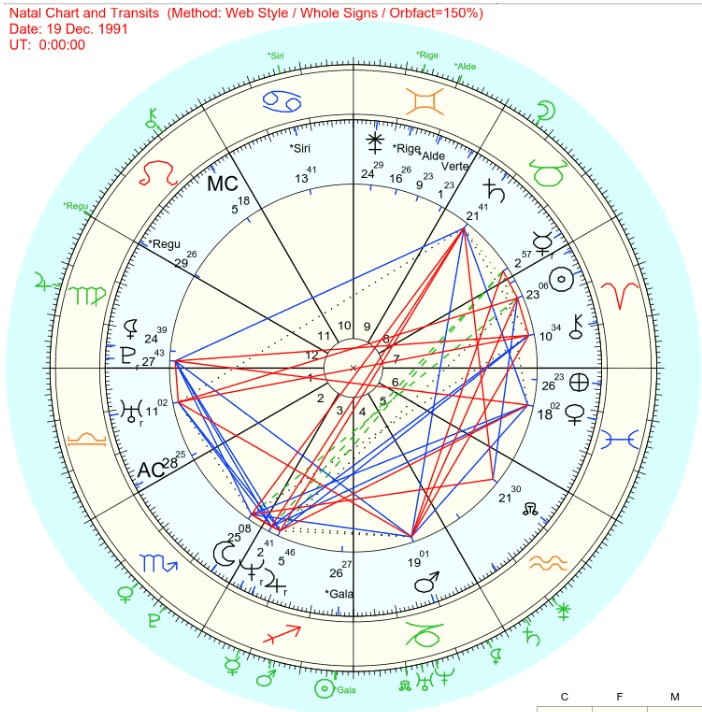
In looking at my friend’s chart for Dec. 19, the day she had to walk away from her studies, Saturn was in Aquarius and Neptune was in Capricorn at the bottom of her chart. The big Saturn-Neptune conjunction that set off the string of events that led to the dissolution had already happened: the two big planets conjuncted on March 4, 1989 when protests and strikes were happening across the communist world. In particular, there was a big worker’s strike in Poland at the time. Then Saturn retrograded back to Neptune and had his second conjunction with her on June 24, 1989, around the time of the protests in Tiannemen Square and when Hungarians dismantled the fence between Hungary and Austria. Then Saturn and Neptune had their final meeting on November 14, 1989, which was five days after the Berlin wall fell.
But the Cold War didn’t end until December 26, 1991 which is when we catch up with my friend. What’s interesting in this chart is that two days after she had to quit her studies, on December 21st, there was a partial lunar eclipse at 29 degrees of Sagittarius in her 3rd house. Lunar eclipses are about letting something go, and it happened in her third house of learning skills of the hands or technical skills. Her third house is ruled by Sagittarius, which is university. Transiting Mars was square Jupiter that day, and transiting moon was conjunct her natal Saturn, emphasizing her dissapointment.
We’re coming up to another historic Saturn-Neptune conjunction in the next few years. Saturn recently entered Pisces on March 7, 2023, and in the 2023 Year Ahead forecast, Austin talks about what this could mean for the outcome of the Ukraine-Russian war. Saturn will actually be chasing Neptune through Pisces for quite a while, and he will get within mere minutes of her in July, 2025, but he doesn’t actually conjunct with her until February, 2026, so it could be a while before we finally see a resolution.
Not surprisingly, Saturn-Neptune doesn’t exactly bring out positive feelings. Astrologer Steph Koyfman, who writes as Lady Cazimi, has an excellent blog post about their duelling nature:
Saturn and Neptune contradict each other in many ways. Saturn represents stone-cold reality, the permafrost of factual truth and factual limits, the boundary between the known and the unknown (quite literally, as it once was the most distant planet visible to the naked eye, and therefore a symbol of the edges of the known universe). Neptune is a fog or a mist prone to suggestion, a vapor that faithfully reflects your projections, the intangible substance of our ideals, dreams, and illusions. When Saturn and Neptune get together, they mutually annihilate each other in certain ways (Saturn scrutinizes, fact-checks, and debunks Neptune’s smoke and mirrors, and Neptune erodes Saturn’s certainty like an ocean dissolves a rock formation). In summary, this is often a process of both sobering up around previous delusions and also no longer being certain what’s actually real anymore.
The pandemic is over, but there’s still a heavy mood in the air. In his book, Cosmos and Psyche, Richard Tarnas explains how the Saturn-Neptune tension at least partially explains that depressive feeling you may be fighting:
A characteristic motif of Saturn-Neptune eras is heightened tension and dialectic between ideals, hopes and beliefs on the one hand, and the hard realities of life on the other. … There is also a tendency during Saturn-Neptune eras to experience a subtle but pervasive darkening of the collective consciousness, sometimes as a diffuse and difficult-to-diagnose social malaise, at other times as a direct response to deeply discouraging or tragic events. Reflecting the complex in its most intense form, such eras are frequently marked by collective experiences of tragic loss, the defeat of ideals and aspirations, the death of a dream, which are accomplished by a sense of profound sorrow.”
– Tarnas, Richard, Cosmos and Psyche, pg. 470.
Knowing this is a long-haul transit, I want to know how to best stay cheerful while contributing to democracy in my neck of the woods. It’s not an easy balance to strike, and lately I’m wondering if I’m expending more energy avoiding the tension of current events than engaging with them. One thing is for sure, that the current American headlines are stressing me hell out.

