Or: “How to Get a MSW in Canada”
If the much more common route to becoming a Jungian Analyst is through first becoming a Psychotherapist (or outside of Ontario, a “Counsellor”), then we need to figure out what tuition is going to look like to do a Masters in either Social Work or Educational Psychology, which seem to be the most common routes to becoming provincially-licensed therapist outside of the straight (more difficult) Psychology route. In this post, I’m just focusing on the former- the Masters in Social Work.
I got one of my undergrads in Manitoba, and another in Saskatchewan, so although I feel emotionally connected to the Western perspective, I feel like I’ve done the Prairie thing. I’d like to study in Quebec because I’d like to someday immigrate to France, and I know France likes that kind of thing. I also wouldn’t mind studying near the beautiful Rocky mountains in British Columbia, so I’m going to take a smattering of university programs across the country and compare their tuition and fees.
** I’m writing all this in January, 2024, so if you’re reading this in the future, you will want to check out the links I provide for updated information and tuition.**
*** Also bear in mind that for some of these schools you’ll be paying for your practicum. I don’t know which ones, I didn’t go into that much detail, but I’m assuming that one semester of practicum fees will be one semester’s worth of fees. But that is a totally unresearched hypothesis!*** Make sure you ask your school what the fees are for the practicum.
1. McGill- Master of Social Work

“The MSW Programs offer course work, field placement training, and research opportunities where students develop an advanced appreciation of theoretical frameworks and empirical scholarships that shape professional practice.”- McGill MSW website
At McGill, they offer you three different ways you can take your MSW:
- the Thesis program (for those who like research)
- the Non-Thesis program
- MSW with Integrated Bachelor of Civil Law /Bachelor of Laws (BCL/JD)
If you go full time, the Thesis program can be completed in two years; the Non-Thesis program is shorter- it can be completed in three terms (semesters). The MSW/BCL/JW takes four years.
Applicants must have:
- Bachelor of Social Work
- A cumulative GPA of 3.2 or higher on a 4.0 scale
- Prerequisite Course Requirements
- [special note for McGill students only]- see website
- It’s not a prerequisite, but you have to have a working knowledge of French if you want to get your Quebec license and have an easier time getting a placement.
You must select your preferred stream:
- Children and Families
- Health and Social Care
- International and Community Development
Tuition and Fees
You have to pay higher fees if you’re from outside Quebec, so to keep things simple, I’m just quoting the fees for outsiders. If you’re a Québécois(e), your tuition will be lower.
Thesis Program (Full-Time= 30 credit hours taken during Fall and Winter Terms)
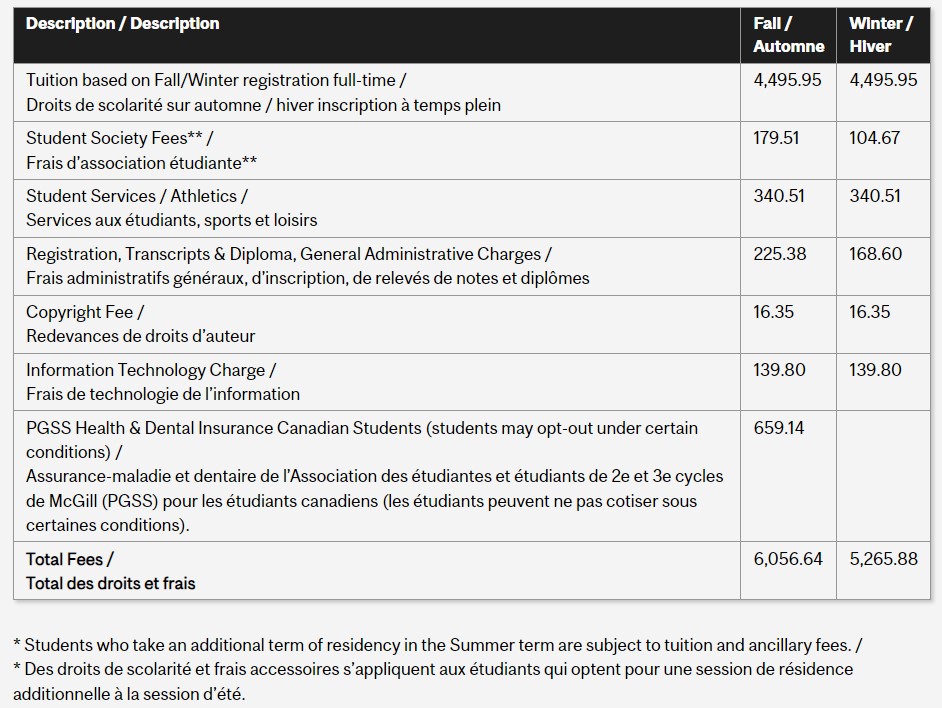
So if the Thesis Program is 2 years long, if we add these two columns together and multiply that by two, we get $22,645.04 for tuition and fees (plus practicum fees?)
Non-Thesis Program (Full-Time = 30 Credit Hours during Fall, Winter… and Summer? [Not actually sure the charge for the summer term])
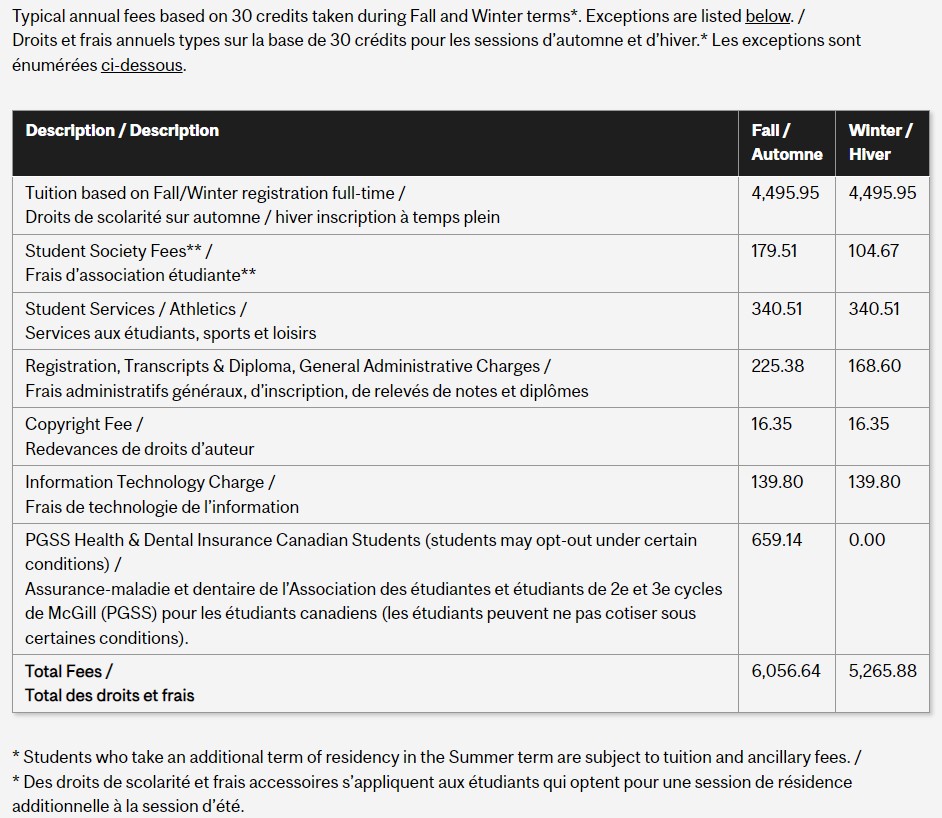
Technically, you can take the third term in either Summer or the following Fall, so I’m not sure which semester’s tuition to take for the third term, but just to be conservative, let’s take the Fall. So if we add these two columns’ totals and add another Fall, we get $17,379.16 (plus practicum fees?).
Once again, these are fees for people who hail from outside of Quebec, and who are studying full-time. A nice bonus to McGill is that living in Montreal can be cheaper. On the flip side, for an outsider, living in Quebec can come with a bit of culture shock.
2. UQAM- Maîtrise en travail social

“Le programme de maîtrise en travail social s’articule autour du développement et de la consolidation des pratiques d’intervention en travail social dans un contexte d’urbanité et de diversité culturelle et sociale. Il met de l’avant une vision du travail social fondée sur le respect des droits humains et la recherche d’une plus grande justice sociale.”
If you were a French Immersion geek like me and you really want to upgrade your French skills, consider UQAM. (And yes, they really are French only.) My ex did his undergrad here, so I feel a teeny bit of connection here.
First of all, I don’t know how big the other programs are, but this one only accept 52 students. You can do this full-time (two years) or part-time (four years).
Let’s see how they structure the program. They have two programs that you must choose upon registering: thesis (Profil mémoire de recherche) and practical work experience (Profil mémoire d’intervention).
Both programs are 45 credits. If you do the thesis (profil mémoire), you must complete 18 course credits: 9 are the mandatory courses, and 9 are courses of your choosing. Plus your research activities (thesis seminar, project and thesis) which come to 27 credits, so in total, you get 45 credits. Same with the work experience one- 18 credit courses (9 mandatory and 9 chosen), then with your work experience of 27, it comes to 45.
Applicants must have:
- Bachelor in Social Work (or social service)
- Cumulative average of 3.2 out of 4.3 (or equivalent)
- If your undergrad is in Entertainment and cultural research, Criminology, Education Pscyhology, Psychology, Communications/ Human Relations, Sexology, Sociology, etc, with a cumulative average of 3.2 out of 4.3, their subcommittee will consider you, although they may assign you preparatory classes first, if approved
- Sufficient knowledge of English to understand 2nd year scientific texts
- Obviously a ton of knowledge of French.
Tuition
I’m really not understanding their tuition schedule because according to the Pdf provided on their site, it looks like BOTH their tracks (recherche and intervention) are Classe B fees, and yet the schedule differentiates between the two tracks:
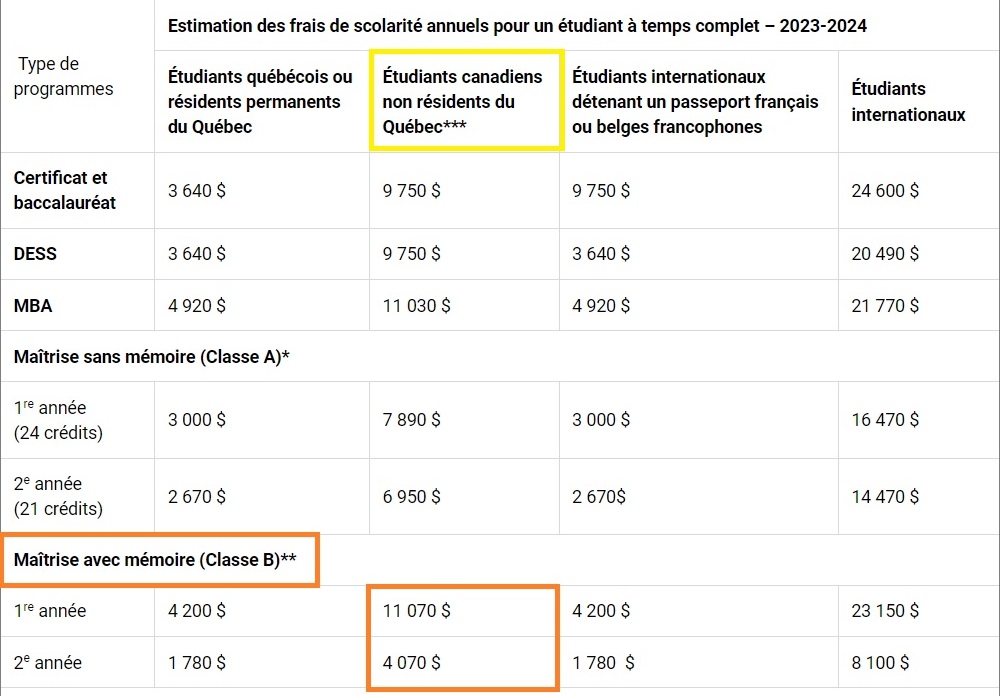
So if we’re really looking at Classe B fees for both tracks, it looks like your 2-year tuition at UQAM for out-of-province students would be $15,140 (plus practicum fees?), which amounts to $2,239.16 cheaper than McGill. I would question if out-of-province anglophones even have a chance at admission, but for what it’s worth, you can pay off an UQAM Masters degree in four years, paying down $315/month.
3. University of Toronto- Master of Social Work

“As the oldest school of social work in Canada, the Factor-Inwentash Faculty of Social Work at the University of Toronto has been on the cutting edge of education, policy, research, and practice in social work for over 100 years. The Faculty offers a professional/academic program of study leading to a Master of Social Work (MSW) and a Doctor of Philosophy (PhD) degree.” – U of T MSW page
At the U of T, there are two tracks- the Advanced Standing track for those who already have their undergrad in Social Work (it doesn’t say how long that is), and the 2-year track for those who don’t. The maximum time you can spend on the degree is 3 years if you’re full-time and 6 years if you’re part-time.
There are six specializations to choose from:
- Children and their Families
- Gerontology
- Health and Mental Health
- Human Services Management and Leadership
- Indigenous Trauma and Resiliency
- Social Justice and Diversity
Applicants must:
- Satisfy the General Regulations of U of T grad school
- Satisfy the their school of Social Work’s additional requirements:
- Applicants with an appropriate bachelors degree with a minimum average equivalent to at least a U of T mid-B in the final year of full-time study from a recognized university (these are admitted to the 2-year MSW)
- Applicants who hold a BSW with a mid-B average in the final year of full-time study, or its equivalent, from a recognized university, may be eligible for the MSW advanced-standing option.
- All applicants must have included 3.0 full-course equivalents (FCEs) in social science courses, including 0.5 FCE in research methodology. A mid-B is strongly recommended in the research methodology course.
- Experience (voluntary or paid) in the social services or related field and knowledge of critical social issues are recommended. Suitability for professional practice in social work will also be considered.
- Ability to speak English
Tuition and Fees
I got the tuition off the Tuition Fee Lookup Tool to get the latest tuition. Unfortunately, it hasn’t been updated for 2024, but maybe it’s a bit early.
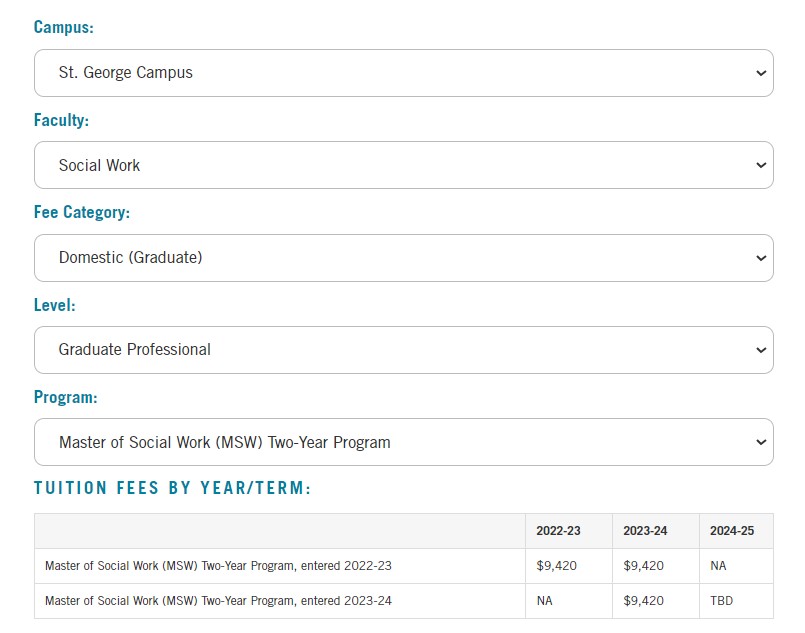
So to do this MSW, you need $18,840 (plus practicum fees?) to do a 2-year full-time Masters. This program, I believe, in on the St. George campus, which is downtown Toronto, and you’d need to find affordable student housing.
4. University of Western Ontario- Master of Social Work

“Our faculty include award-winning faculty with expertise in diverse areas of social work practice, such as social inequity, mental health and addictions, structural and clinical social work, organizational leadership, and transnational practice.” – King’s College Website
Something I didn’t know is that the University of Western Ontario is also called Western University, which, as you can imagine is a little confusing to an actual westerner, Their MSW is actually offered through King’s University College, which is a religious/spiritual/social-justice affiliated college of the UWO. With them, as with the U of Toronto, you can either do a 1-year advanced-standing MSW for those who already have an undergrad in Social Work, or a Foundational program for those who don’t that takes two years. In each year of the program, you get 450 practicum hours.
If you have advanced standing, your program will be 3 terms, and if you are taking the foundational program, your Masters will take 6 terms.
Advanced Standing Applicants MUST HAVE:
- Completion of an accredited Bachelor of Social Work (BSW) degree.
- Successful completion of a course in Research Methods (including instruction in both qualitative and quantitative methods). There is no specific minimum grade requirement.
- A minimum average of 70% in academic courses taken in the last two years of full-time study during the undergraduate degree, or the last 20 half-courses in part-time study.
- Verification of completion of academic requirements must be available by August 31.
- A minimum of 1,000 hours of relevant experience (paid or unpaid) in social services.
Foundational Applicants must have:
- The completion of a 4-year Bachelor Degree.
- Successful completion of a course in Research Methods (including instruction in both qualitative and quantitative methods). There is no specific minimum grade requirement.
- A minimum average of 70% in academic courses taken in the last two years of full-time study (during undergraduate or graduate degree), or the last 20 half-courses in part-time study.
- Verification of completion of academic requirements must be available by August 31.
- A minimum of 1,000 hours of relevant experience (paid or unpaid) in human or social services.
Tuition and Fees
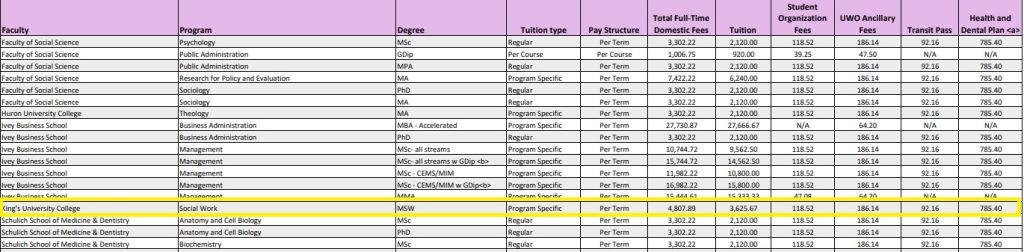
UWO doesn’t have their tuition posted yet for 2024 (makes sense, it’s a bit early), but here are their 2023/2024 full-time graduate rates. The picture below is a bit blurry, but it’s $4,807.89/semester, which if you’re taking the Foundational (6 term) Masters, you’ll be paying $28,847.34. I’m assuming this includes your practicum, but I’d verify that.
5. Simon Fraser University

Simon Fraser doesn’t appear to have a Masters in Social Work.
6. UBC- Master of Social Work

“We believe that to be effective social work practitioners, we have to understand the dynamic interaction between the biological, psychological, and social domains.”- UBC MSW website
The Master of Social Work at UBC takes place on their Okanagan campus!! If that’s not enough incentive to pivot careers, I don’t know what is.
Like others listed above, they have two tracks- if you already have a BSW, you can do the Advanced One-Year Track which includes 30 credits plus a 6-credit practicum. You cannot do this part-time.
The Foundational Two-Year Track is for those who have an undergrad in (preferably) the social sciences or behavioral sciences. You complete 60 credit hours and 2x 6-credit practicums.
Applicants to the Foundational Track must have:
- a minimum grade average of B+ (76-79%) or higher in 300-level courses in their undergraduate degree program;
- English Language Proficiency- see website
- a completed [approved] 3-credit course in statistics
- a completed [approved] 3-credit course in research methods
- a completed Statement of Purpose — see FAQs
- provide three letters of reference — see FAQs
- a current resumé or curriculum vitae.
- Preference will be given to applicants who meet the above criteria and have related paid or volunteer social-work experience.
Tuition and Fees
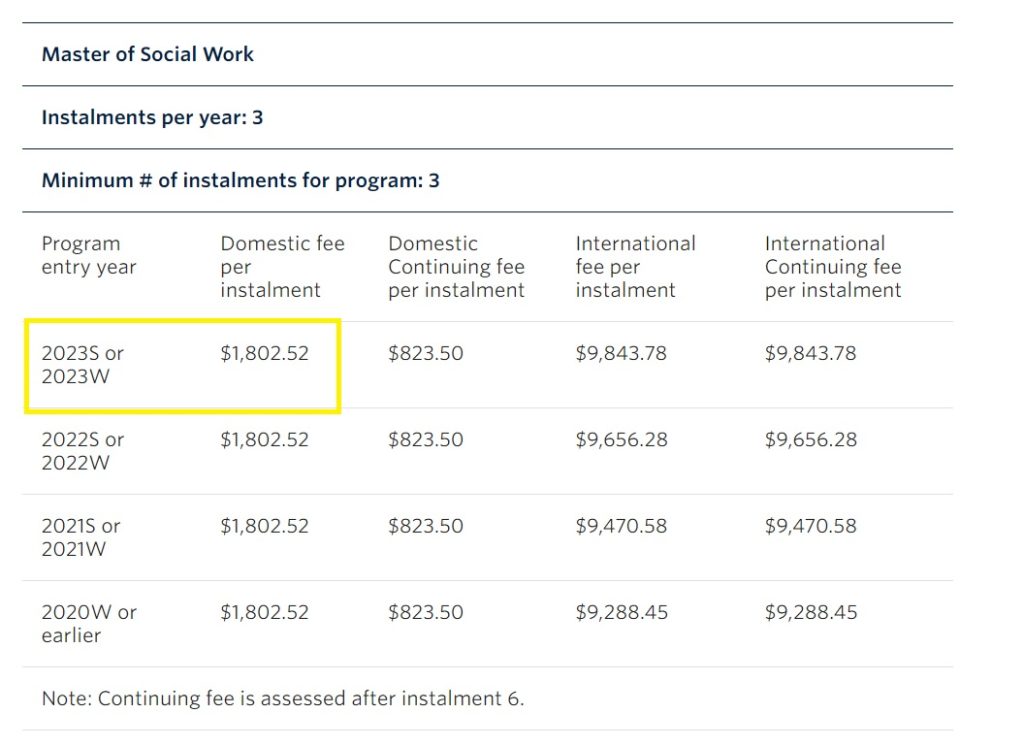
Tuition fee instalments are applied to the student’s financial account in three equal instalments in Winter Term 1 (September), Winter term 2 (January), and Summer Terms 1-2 (May) of each year.
According to their tuition schedule, 6 terms is: $10,815.12. What? I am completely floored by this affordable price. This is the cheapest tuition I’ve listed by far. I went up and down the grad tuition schedule to compare the MSW tuition to other programs, and it is fairly comparable to the others (not even the lowest). Check it out for yourself if you’re interested, but this seems to also include your practicums (to which you are assigned in the summers).
Given this affordable tuition, I’m tempted to apply just for fun. To compare how lucky they are compared to Regina residents, let’s compare tuition for the University of Regina.
7. University of Regina- Master of Social Work

“In this program, students will develop advanced social work techniques, gain a deeper knowledge of modes of social intervention, and become aware of broader aspects and issues of service delivery, social policy analysis, and social welfare research.”- U of R MSW page.
It looks like there is only one track: you must have a Bachelor in Social Work first, but if that’s you, you have two options:
- Thesis
- Practicum
It looks like the program should be a year long. I’ll let them explain:
“MSW students are given the option of completing our program requirements with a thesis or practicum (30 credit hours). The thesis requires six courses including two research courses, a Thesis Proposal course, two electives, and a thesis. The practicum option requires six courses, including two research courses, four electives, and a field or research practicum.”- MSW page
So the Thesis track is:
- 6 classes (including two research courses)
- 1 thesis proposal course
- 2 electives
- 1 Thesis
For a total of 10 courses.
The Practicum track is:
- 6 classes (including two research courses)
- 4 electives
- 1 field or research practicum
For a total of 11 classes.
Applicants must have:
- Attainment of a BSW
- A qualifying graduating average of 70%
- At least two years demonstrated professional experience in the human service field
- Two written references, preferably one professional reference and one academic reference
Tuition and Fees (I’m using 2023-2024 numbers)
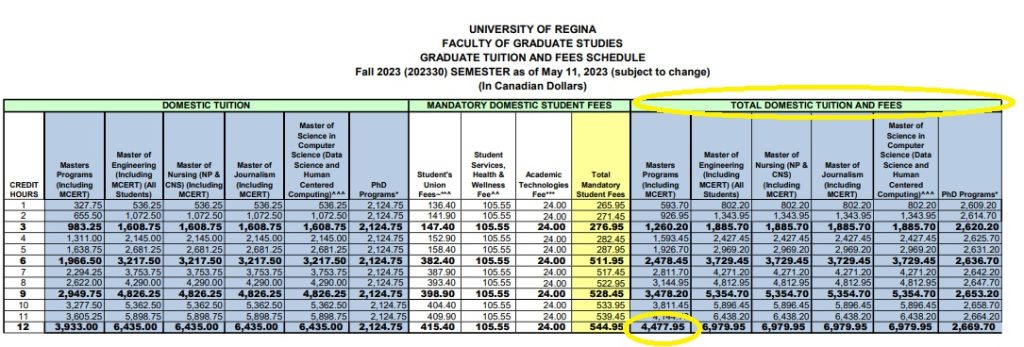
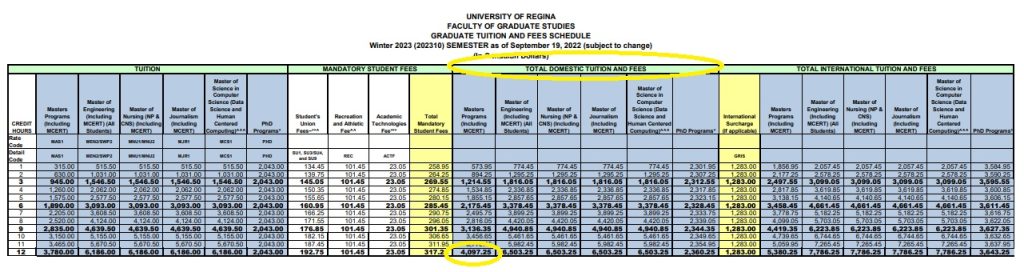
I’m not really understanding how this works- in these charts, the highest amount of credit hours is 12- that means students are only taking 4 classes (if their courses are 3 credit hours each). There is much more information here, but it doesn’t talk about credit hours, so I don’t know if this is accurate, but if we take $4,477.95 + $4,097.25, we get $8,575.20, which cannot be right because they’re saying that your thesis/practicum have to take up 450 hours which I’m not sure if you do during the year, or after the year. If you decide to attend the University of Regina, make sure you contact them to find out the actual cost because I might be missing something.
(Once again, sorry my pictures turned out blurry below – you can access the tuition schedule here.)
Fall 2023
Winter 2024
Either way, all this digging has made me realize that I don’t want to do a Masters. Not only does thinking about doing another degree exhaust me, but so does the idea of debt. If I do take on debt at this point in my life, it’s going to have to be for what I actually want to be studying: something in the depths.
If you can’t decide what to do about your higher education, in a later blog post, I’m going to talk about the D-24, which is the Indian varga chart for higher education, and how the “health” of your Jupiter can give you a sense for how higher education will contribute to bettering your life. (Actually, I have recently re-directed toward a more spiritually-focused career based on consolidating some insights from my birth chart, my D-4 (wealth chart), my D-9 (adulthood chart), my D-24 (higher education and spirituality chart), and my D-60 (end of life chart).
If you’re thinking about doing a MSW or just becoming a Jungian analyst, leave a comment below on how you’re designing your track.

