I’ve been humming and hawing for years on what I should do after graduating with my Political Science degree. I didn’t know if I should aim at a masters at all, and if I did, should it be in Psychology or Political Science? I’m interested in the intersection between the two (along with astrology!), but when I look at MA’s in Political Psychology (for example this one at Ohio State), they’re moreso to do with how to market a political party to win votes. I could be interested in a sliver of that, but it’s not my passion. Because my boyfriend has been reading so much Jung lately, the thought crossed my mind that I should investigate becoming a Jungian analyst, so I decided to send off a few inquiring e-mails. I’m in my 40’s and with two undergrads, the last one taking me 20 years to complete, if I go for the MA, I would like to get the most bang for my buck.
By way of disclaimer, this is not intended to be authoritative in any way, this is just a record of what I’ve found so far in my research. In this article, I present quite a few links you can click on for more details, but of course, e-mail the local chapter of IAAP in whichever country you’re in for the final word. Since I’m in Canada, I’m referencing Canadian sites, and to make things relatively easy, Canada only has one Jungian analyst society that is recognized by the international governing body of Jungian analysts, the IAAP, and that is the Ontario Association of Jungian Analysts.
This is a long article, but there are two “short answers” to how to become a Jungian Analyst, depending on your route:
- If you want the title of Psychoanalyst1 or Psychotherapist, and you want to be licensed by your province AND be a Jungian Analyst who is a recognized member of the IAAP, you need to have an MA in Clinical Psychology and be a licensed psychotherapist before you enter most Jungian programs. In order to get into most Clinical Psych programs at universities across Canada, you need to do an undergrad in Psychology, do an Honors, get exceptional marks, do the GRE, and compete against probably several thousand applicants across the country for a limited amount of spots. If reading that gives you anxiety, you can also do counselling with a Masters in Social Work or a Masters in Education, I believe. I found this article really helpful as a jumping off point for more reading.
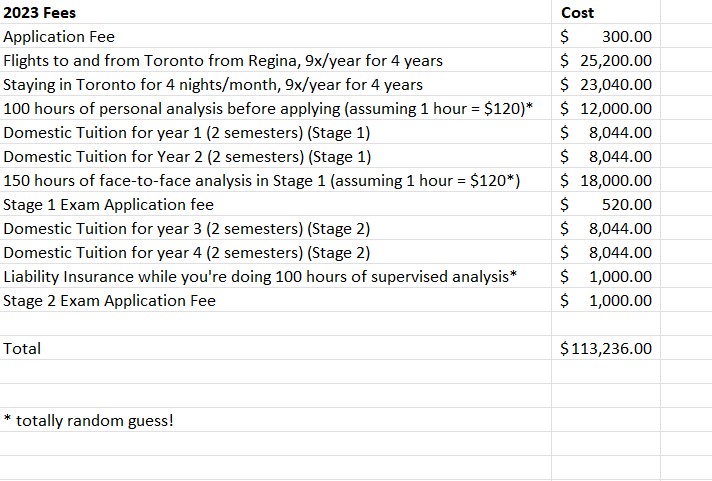
- 2. If you don’t have a Masters that qualifies you for a provincial license to be a clinician, there is another way to become a Jungian Analyst, and the Ontario Association of Jungian Analysts is one of the (few?) associations that provides that other way. It involves having “a graduate degree or equivalent” (I’m not 100% clear what an equivalent might be, but I’ll expand later), but if you get in, it takes at least four years, and the 2023 OAJA tuition is $4,022 per semester, meaning tuition alone for your four years is CA $16,088. This doesn’t include travel to and from the school 9 times per year, the cost of 100 hours of personal Jungian analysis before applying, the cost of 300 hours of personal Jungian analysis while in the program, and the various fees you pay along the way for registration, exams, books, insurance to practice, and other sundries. For someone from the Prairie provinces, like me for example, who’d have to travel back and forth for four years for courses, let alone for analysis appointments, we’re looking at more like CA $113,236 (not including books or other fees that may not be listed on the website). (You’ll see my excel spreadsheet with the breakdown below.)
Now here are some long answers, starting with OAJA.
OAJA (Ontario Association of Jungian Analysts)

I wrote to the Registrar at OAJA today, asking what the exception to the MA would be for route 2, and he said,
Regarding equivalency, here is what our regulations say:
“In granting equivalency, a number of factors are to be considered. In some exceptional cases an applicant can demonstrate significant other educational endeavours and/or work experience in order to be granted equivalency to a masters degree. The important point is the demonstrated capacity for independent, self-directed education, research, organization, and discipline. All these are qualities and skills which will be taxed to the fullest by analytic training.”
Equivalency is decided by the applicants Selection Committee.
– personal e-mail correspondence with OAJA, January 12, 2024
This could include me, or it may not, I really don’t know. I do have to say how grateful I am that the Canadian chapter seems to subscribe to the idea that just because you get stellar marks in your Psych classes in university, it doesn’t mean that you’re interested in taking the holy path inward and down the dark staircase to your own unconscious. I have always found it weird how hard it is to get into the Clinical Psych program. My sister did her undergrad in Psych, did an honors, graduated on the honor roll, has a cheerful, friendly personality, and took the GRE (not sure of her mark), and even she wasn’t able to get in, so if they reserve the spots for students with even higher marks, what is the mental health of their successful candidates? I’m so curious.
Here are their entrance pre-requisites for OAJA as stated on their website:
- Analysis: At least 100 hours of personal Jungian analysis with an IAAP member by application date of November 15, with a minimum 25 hours in the past year.
- Education: A graduate degree or equivalent (contact the Registrar for further information about equivalency).
- Age: 30 minimum.
The program is in two stages, each taking 2 years. The first stage is more learning and observing, and the second stage involves more supervised practice.
I do have questions about their client work requirement. Their regulations say that “Before Stage Two exams, advanced candidates must accumulate a minimum of 300 hours with clients of their own, involving at least five analysands:
- one case of 80 hours minimum
- one case of 50 hours minimum
- and three cases of 20 hours minimum each
If one is taking the second track where you’re not already a licensed counselling practitioner, where you do get these kinds of dedicated clients? It seems like a gamble to start with a client and hope they stay with you for 80 hours, so I’m assuming you’d have to offer them a lower rate to incentivize them to stay that long. That also begs the question: if I come in as an astrologer with a private astrology practice, am I busy marketing like crazy to get astrology clients in order to build up to 300 hours? 300 hours is a lot for someone who is just starting out and doesn’t even have her website up and running officially. If I see 2 clients a day, that would take me 150 days or 5 months. I guess that’s not too bad…?
In terms of cost, here is a breakdown of the fees I gathered off their website (you can adjust it for your situation):
OAJA’s school is in Toronto, so if I stay on the Prairies, I budgeted 700$ for each round trip to Toronto. I also budgeted $120/night at a hotel. I’m looking at that total, and I’m thinking at this price, one might as well put that money in the stock market and use the dividends to pay for an astrology diploma at Keppler College. If I’m in my mid-40’s, will I make enough over the course of the next twenty-five years to justify spending $113,236 on four years? It appears part-time, so I can still keep my day job, I believe, at least for the first two years. I need to find out how much Jungian analysts charge per hour and how busy I can expect to be. One thing is guaranteed: if I stayed in Saskatchewan, I’d be the only Jungian analyst in the entire province.
The Inter-Regional Society of Jungian Analysts
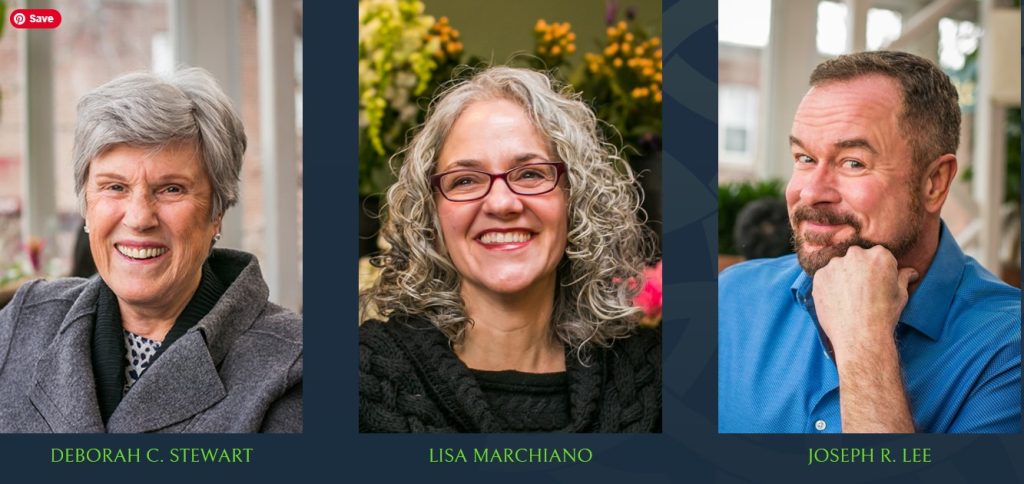
While I was searching online for analyst training schools, I stumbled upon this youtube podcast which I highly recommend, whichever route you’re choosing: This Jungian Life. Their podcast on How to Become a Jungian Analyst is hosted by three American Jungian Analysts who trained through the Inter-Regional Society of Jungian Analysts. All three of them went the standard route of state-licensed practitioner to Jungian analyst. The IRSJA is based in the US, but they do include Canada and Mexico as well, so I looked into their admission requirements. In the podcast, they say, “All applicants must possess at least a Master’s degree, and that the graduate degree would qualify the applicant to practice psychotherapy in their state. They would need to obtain that licensure prior to entering into our supervisory stage of training.” I went to their website to see if they left something out. They didn’t: “The Inter-Regional Society’s training program is post-graduate in nature. Most successful applicants have at least a master’s degree in a mental health field. Many are already licensed mental health providers in the jurisdiction in which they practice.”
The podcasters give some context:
So some people question, “Why would a Master’s degree be required to come into training when [you could come] right after high school or perhaps out of a Bachelor’s degree?”
Right, there is a tradition of – kind of – “the lay analyst”, so the person who was trained to be an analyst without being a mental health clinician prior, and there are institutes who will train people who don’t have prior mental health experience. The Inter-Regional is not one of those institutes. They are looking to train people who are already clinicians.
“…And some of the controversy around this is ‘If we’re really oriented to psyche, what do we need to worry about the DSM and diagnosis, and all this other kinds of stuff?” And I can see the point, and like I said, there are institutes that train that way now, but the truth is that if you’re going to practice as an analyst, you’re going to have people walk through your door who are depressed, or who maybe have bi-polar disorder, or who have a drug and alcohol problem, and you better have some familiarity with those kind of … bread and butter stuff, because we’re all not just one thing, right? So to get the broadest grounding possible makes a lot of sense…”
This Jungian Life: How to Become a Jungian Analyst, 4:35
It’s true- when I hear someone talk about their bi-polar disorder, I’m thinking about their Mercury, Moon, Uranus, and Pluto in their chart. I won’t necessarily have the knowledge to distinguish between Bi-polar I (manic) or Bi-polar II (hypomania and depression). Will astrology and mindfulness have strategies that can work alongside their medication? To what extent do I want to be helpful? Yesterday and the day before at work, I had what I think might be formal panic attacks, although I’m not sure. My regular mindfulness techniques of noticing my body, taking deep breaths, and making a list of reasons to be grateful weren’t really working as well as they usually do when I’m stressed. I was trying to think what transits might have prompted this and I believe it was last year’s October 28 lunar eclipse in Taurus which affected my 12th house. Knowing the planetary cause did help reassure me that this high level of stress was [hopefully] temporary. Is that the kind of service I want to provide for clients? With my 3rd house lord in the 12th house, I know that any skill I provide must draw people into the spiritual realm, and I don’t know if I want to waste my time as a provincially-licensed clinician trying to convince people who aren’t interested in spirituality to go there. That sounds like an exercise in frustration. Although I also know that with a good listening ear, which I’m good at providing, people tend to go there themselves.
Going back to the podcast, one of the presenters, Deb, is on the IRSJA admissions committee, and at 14:00, she lists some things the committee looks for, which I’m assuming is what the OAJA would be looking for too:
- Motivation: “What is motivating this applicant?” A desire to meet others in their depths? to meet a career ambition? Some sort of need to understand oneself? What is going on there?
- Time commitment, the time spent in personal analysis
- The sense of the person we get in the interviews “because [they’re] pretty intense, [they’re] not an easy-going conversation”
- One’s clinical experience. “We do want to see licensure, and we want to see experience with people and working in this field, so that you know that this is for you, and you’ve at least wet your feet, so to speak”.
- Resources. “The analytic training process is estimated to cost between US$15,000 to $20,000/year. It’s travel, books, seminar fees, and your own analysis and supervision.”
- Inner cohesion: “Your own basic sense of yourself, comfort with yourself. A kind of basic cohesion or integration that says I’m really ready for this.”
Pacifica Graduate Institute
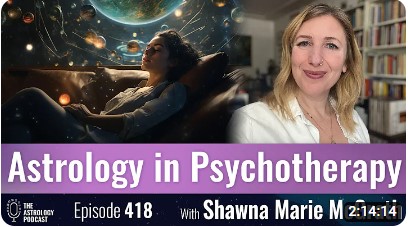
I had initially become interested in the Psychological route when I watched this podcast of Shawna McGrath with Chris Brennan on his Astrology Podcast. Shawna is an American astrologer who wanted to help her clients better with the tougher stuff, so she enrolled in Pacifica College in California and did their two-and-a-half-year MA in Depth Psychology. However, when I looked at Pacifica, they were very expensive for a Canadian- it looked like that particular program would end up costing around CA $150,000 with tuition, fees, and travel. At least with Pacifica, you’d get the MA as well as the accreditation to license in California to use the label “Psychotherapist”. From searching around the internet, Pacifica has a pretty solid reputation, aside from a few unhappy posters on Reddit. As a Saskatchewan resident, you always have leaving the province in the back of your mind anyway…
I did write to the Saskatchewan College of Psychologists to see if they would accept that as suitable education to qualify me to practice in Saskatchewan, and it looks like, due to it being accredited with CHEA in the USA, it would qualify, at least in terms of it being a “recognized institution” (point i). In their e-mail, they say, “The academic requirements for registration with the Saskatchewan College of Psychologists are outlined in The Psychologists Act, 1997, and applicants must:
i) Have completed a master’s or doctoral program at a “recognized institution”;
ii) The master’s or doctoral program must be primarily in psychology;
iii) The applicant must also meet the Foundational Knowledge requirements, but these courses may be taken outside of the program which they intend to be licensed under.“Since this institution is located in the United States, it would have to be accredited by one of the six regional accreditation bodies to meet point 1 above; you can confirm whether the institution is accredited by visiting www.chea.org. If you choose to complete your program in Canada, the institution you choose must be listed on the Universities Canada website to be eligible for registration: www.univcan.ca/universities/member-universities/.
Along with the program needing to be run by an institution recognized by the Saskatchewan College, it also must be primarily in psychology (at least 51% of the courses must be in psychology; courses in counselling, education, psychotherapy, etc. cannot be applied towards this requirement).
The applicant must also be able to meet the four Foundational Knowledge requirements; however, if an applicant’s program did not sufficiently address one or more of the four FK areas, they can supplement by completing a graduate-level course in the missing FK area during their provisional registration period.
– personal e-mail correspondence with the Saskatchewan Colleges of Psychologists, Nov 14, 2023
Now that I re-read those criteria, I see that they distinguish between Psychology and Psychotherapy. “At least 51% of the courses must be in psychology”, and honestly, when I read the list of required courses, I don’t know how many Saskatchewan would consider Psychology. I’m guessing at least half of them belong in the Psychotherapy bin because this is what Saskatchewan wants to see covered:
FK 1: Knowledge of the Biological Bases of Behavior (Examples: Physiological Psychology, Comparative Psychology, Neurophysiology, Sensation and Perception, Psychopharmacology)
FK 2: Knowledge of the Cognitive-Affective Bases of Behavior (Examples: Learning, Cognition, Motivation, Emotion)
FK 3: Knowledge of the Social Bases of Behavior (Examples: Social Psychology, Group Processes, Community Psychology, Environmental Psychology, Organizational and Systems Theory, Cultural Issues)
FK 4: Knowledge of the Psychology of the Individual (Examples: Personality Theory, Human Development, Psychopathology, Individual Differences)
I was going to say, the worst case scenario is that if I didn’t have enough courses from them to cover all the four Foundational Knowledge requirements, I’d just have to take some extra top-up courses, but actually, the revised worst case scenario is that Saskatchewan only accepts 49% of Pacifica’s courses and I have to emigrate to the US to practice. And frankly it looks like a big administrative headache to get an MA in another country- can you imagine Saskatchewan hustling to help me find a supervisor for the required “300-hour practicum in my home community”? For a school they’d probably barely heard of? I can’t.
Yorkville- EDIT* 2023-01-14- Sask College of Psychologists does NOT accept Yorkville

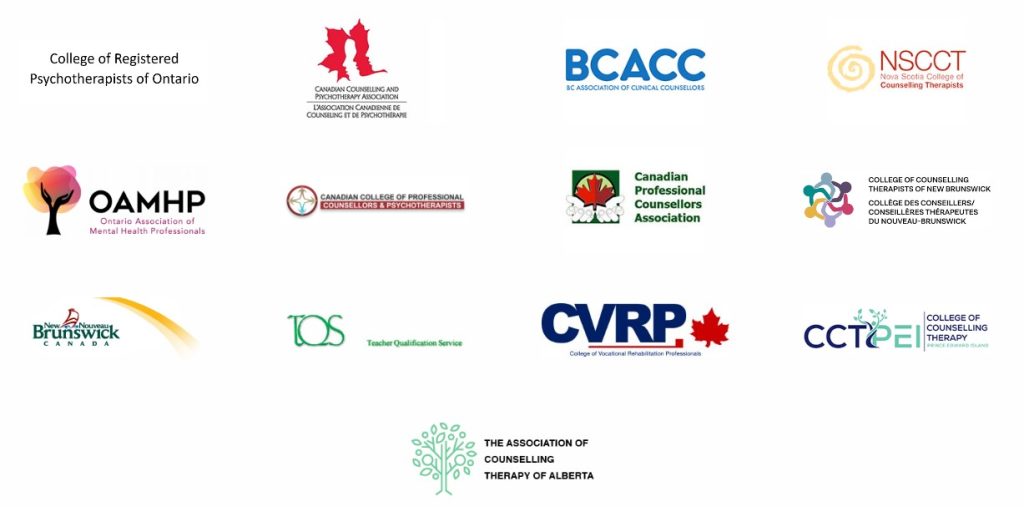
I wanted to see if I could cut out the cost of travelling or moving, so I looked for an online school in Canada that could qualify me for the title of Psychotherapist or Counsellor. The first hit that comes up in google is Yorkville, an online university that offers a Masters of Arts in Counselling Psychology for $43,610 as of their 2023 tuition rate. They say they are the first online counsellor education degree in Canada, and their Master of Arts in Counselling Psychology is “recognized by provincial and national associations and regulatory bodies, allowing our graduates to apply for registration/membership with the following associations:”
You don’t see Saskatchewan on this list, but when I wrote to one of their admissions counsellors, she said it was accredited in Saskatchewan:
Is the MACP Program Recognized in My Province/Territory?
Yes! In Saskatchewan, MACP graduates are eligible to apply for professional membership and Canadian Certified Counsellor (CCC) designation with the CCPA. Counselling is not regulated in Saskatchewan, but membership with this national association is recommended to all MACP graduates as it provides many professional benefits.
– personal e-mail correspondence with Yorkville University, September 15, 2023
So here we find something interesting: “Counselling is not regulated in Saskatchewan.” What does that mean? Based on my correspondence with the Saskatchewan College of Psychologists (mentioned earlier), they were telling me that a qualifying MA allowed you to license with them, so then why would you want to get an MA to be a Counsellor with Yorkville? Can you call yourself a Psychologist with an MA in Depth Psychology from Pacifica if it fulfills point 1 with the SCP? I’d have to ask. I’m kind of confused what your title would be if you got the qualifying MA for the SCP.
Anyway, back to Yorkville. When I asked about their coverage of Jungian studies, she replied, “Jung’s theory is touched on, but not in depth. Our MACP focuses on behavioural and Cognitive modalities, along with humanistic and psychodynamic approaches.” So it’s a possibility to go the complete “secular” route and tack on your Jungian studies later on. It’s not like I’ve ruled it out. I just question the reputation of the school, like how well-known it is in the Psychological community, being new, and being online? I know the snobbery against Athabasca University, I’m sure Yorkville experiences the same blow-back. I absolutely love the fact that it is online, and you can do it part-time. That is tremendously appreciated by people who live in the more out-of-the-way Canadian cities, it just hurts that we have to decide between reputation and access. And if you’re wanting the provincial accreditation with the Jungian Analyst designation, you’re essentially going to be paying for two Masters-level programs- theirs and OAJA’s- and I am just not into that.
* EDIT- 2023-01-14 – If you do your Masters in Counselling with the intention of one day becoming a Psychologist, at least the Saskatchewan College of Psychologists will not accept Yorkville as an MA. See my Part 3 for more.
Just Doing Something Else
I have considered just doing other things:
- Astrology diploma at Kepler College. Although Chris Brennan, a central figure in the astrology space today, did warn at the beginning of his Professional Astrologer course that nobody goes into Astrology for the money- it is not something that has big returns. I’m imagining a lot of busy and hardworking astrology professionals top out at $50,000. I could be wrong, I’d love to know.
- The qualifying courses with the Enneagram in Prison Project. The Enneagram is my first love, and I know the power the Enneagram to turn a person’s life around for the better. I often wonder if I’d be of use bringing the Enneagram into prisons. I’m friends with the first woman in Canada to successfully bring their Enneagram program into a Canadian prison, and she has done it right here in northern Saskatchewan. I’m also friends with a guy in Minnesota who is working through the program. I love that, and prison is a very appropriately 12th house area for me. However, working with the EPP, I’d be dependent on donations, and that is even riskier than option 1. They have two training programs, and I think the first one is about $750 CAD. I know the second one is $2,683.70 CAD ($2000 USD). However, would I have to move to Northern Saskatchewan to “make my living”?
- Just doing Diamond Heart. My good American friend recently forwarded me a link for Diamond Heart’s FIRST ONLINE GROUP! Speaking of not being able to access resources when you don’t live in a big, sexy city, let me tell you. It is frustrating when organizations don’t move their spiritual teachings online. Finally, Diamond Heart is opening itself up to the concept of online-only participation. Between all the fees, I believe I calculated that a year with their group would cost $1,000, and I’d get lots of one-on-one sessions with the teacher. That’s nice. I’m not crazy for their teachings necessarily, but I would love one-on-one time with someone, especially this year with Pluto going into my 4th house and I’m feeling a nudge to dig into some rather Plutonian material. I also love their partner exercises- I get a lot out of them. I’ve already said no to that group due to the time commitment on the weekends, but I could maybe change my mind still. The problem is that they don’t give you some kind of diploma or accreditation at the end. At the end of the year, all you get is an invitation to pay the fees again for another year.
ROI of a Masters
So what if I take all the money I would’ve otherwise put into training and put it in the stock market- would I be better off? I went to Investopedia’s webpage on calculating the ROI of the education program because nobody quantifies the value of an education better than prospective MBA students.
The author of the article creates a benchmark of investing in US Treasuries: “The safest investment in general for most retail investors is a U.S. Treasury bond. Because these investments are so safe, the return paid by the U.S. government is very low. Over the last 20 years, this would have resulted in just around a 3% ROI (through the end of 2022).
He explains how he justifies the cost of his MBA compared to that 3%:
After earning a bachelor’s degree at CU, I went on to earn an MBA from the University of Denver. That private school’s MBA cost about 33% more than my in-state cost of attendance at CU. While some people might argue that I had a better use for $90,000, I was debt-free two years later, and my income has had several large jumps, which I attribute to my MBA.
Right after I graduated from my MBA program, I found a new job that would never have happened without the networking I did at school. It brought me a modest $5,000 raise, but over 20 years that covers my entire cost of attendance plus an extra $10,000. Any raise over that increases my ROI. Three years later, I received a 40% raise when I accepted a job—one that I would not have been qualified for without the MBA. If I stay at the same salary as today and never get another raise, that is an 889% ROI on my MBA.
Rosenberg, Eric, Investopedia, College Tuition vs. Investing: Is It Worth It?
I googled to see what a Jungian Analyst makes in Canada, hoping Stats Canada included it in their census, but alas, the closest I got was how much a Stats Canada analyst makes, and it’s $72,500. True, the two kinds of analysts have nothing in common, but I’m actually just going to run with that number. Let’s say I make $72,500 as a Jungian analyst, starting at age 50 (giving me 5.5 years to graduate). I have 15 years after that until retirement at age 65, although of course I could work longer than that. If I live off my current salary in order to pay off my debt, that frees up $13,714 each year to go towards my debt. Let’s say my loan is for $113,236, at 5%, I would have to put $1,201.04 per month towards my debt, in order to have it paid off in 10 years. That means annually, I’m paying $14,412.48 toward my debt, which actually puts me in the red. I’d be dipping into my current, lower salary in order to meet that 10-year payoff deadline. Then for the last 5 years of my career, I’m enjoying that extra $13,714/year, part of which will get eaten up by inflation. So I’m essentially giving myself a $10,000 raise for the last 5 years of my career.
God, my life would be so much easier if I enjoyed math- I could just do an MBA and pay for Jungian therapy for the rest of my life with the interest I make off my savings account.
- This is not an official statement, but this is what I think I’m finding: at the MA level in Canada, we tend not to use the word “psychotherapist” as much as they do in the US. Broadly, we tend to use the word “counsellor”, although Ontario does use “psychotherapist”. There are so many titles, check with the Canadian Counselling and Psychotherapy Association for all the titles they recognize under their umbrella.) ↩︎